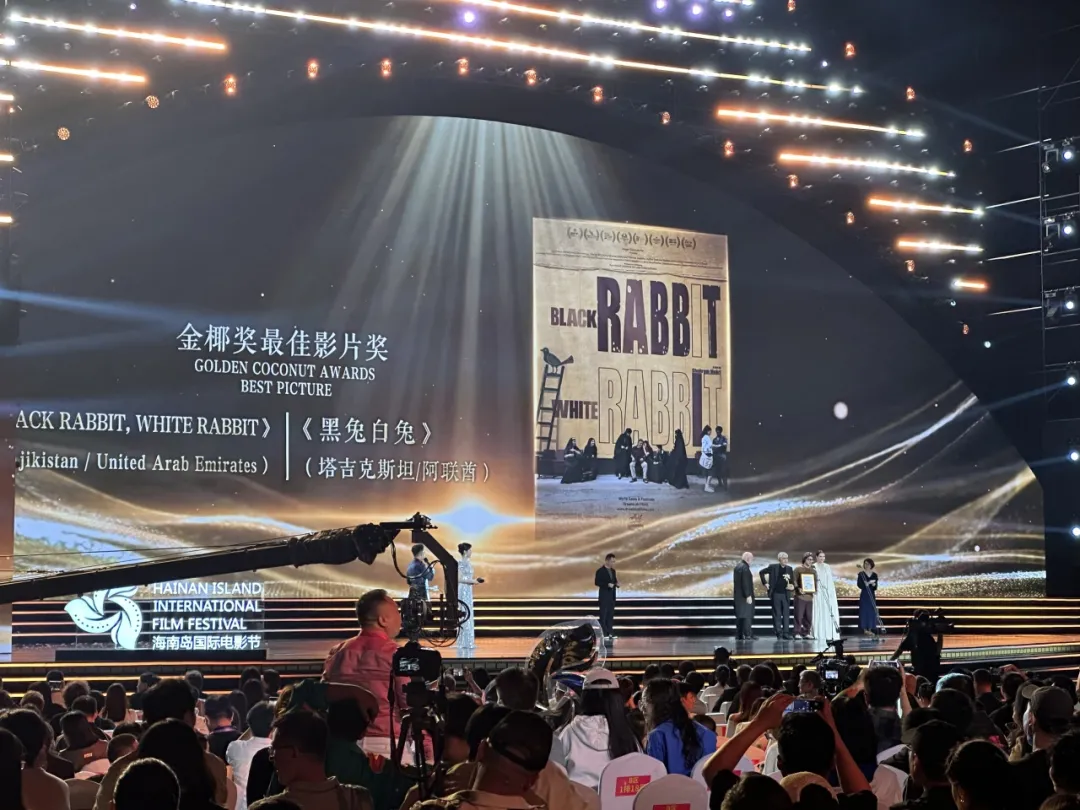
On December 9, at the closing ceremony of the 7th Hainan Island International Film Festival, the winners of this year's "Golden Coconut Award" were announced.
The Golden Coconut Award for Best Film went to the Tajik film "Black Rabbit, White Rabbit"; Chinese director Li Hongqi's second feature film, "I Am the Happiest Baby in the World," shared the Jury Grand Prize with the German film "The Desire of Sangerhausen"; Joel Alfonso Vargas won the Golden Coconut Award for Best Director for "The Crazy Bill," and the film's three leading actresses, Destiny Checo, Johanna Florentino, and Natalie Navarro, shared the Best Actress award for their roles in "The Crazy Bill."
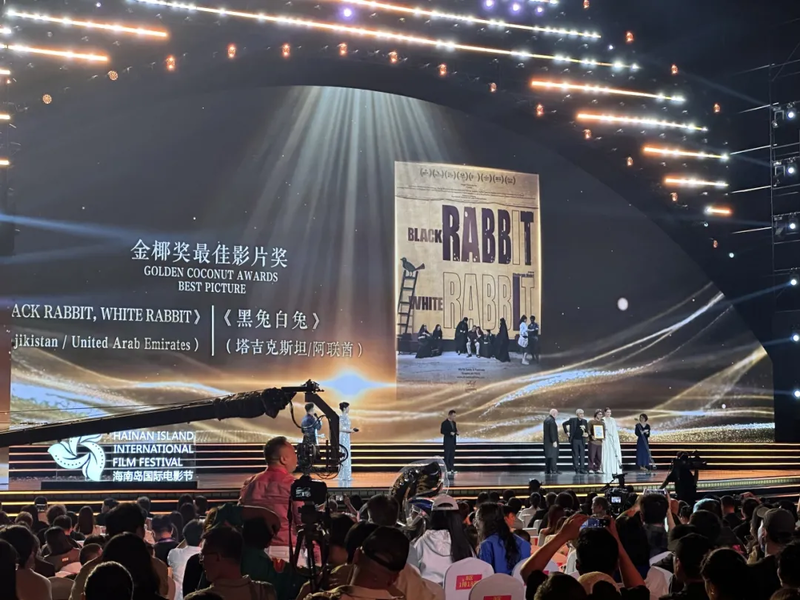
"Black Rabbit, White Rabbit" won Best Film
As one of the pioneering projects in the construction of the Hainan Free Trade Port, the Hainan Island International Film Festival has attracted widespread attention from filmmakers around the world with its professional judging standards and diverse cultural perspectives. The winning works of this year's Golden Coconut Awards cover multiple categories such as feature films, documentaries, and short films, fully demonstrating the richness and diversity of contemporary film creation.
This year's Golden Coconut Competition featured a stellar lineup of films, many of which had already garnered recognition at other film festivals earlier this year. In the Best Film category, "Black Rabbit, White Rabbit" emerged victorious, winning this prestigious award thanks to its profound thematic expression, masterful narrative techniques, and outstanding performances. The film seamlessly blends reality and fantasy, breaking conventions and using long takes and multi-threaded storytelling to engage the audience's emotions and prompt reflection.
Although the two works that won the Jury Grand Prize have their own unique characteristics in terms of subject matter and expression, they both won the jury's recognition for their extremely high level of creative achievement. "The Desire of Sangerhausen" explores the complexities of human emotions with its delicate psychological descriptions and calm narrative pace; while "I Am the Happiest Baby in the World" touches people's hearts with its sincere emotional expression.
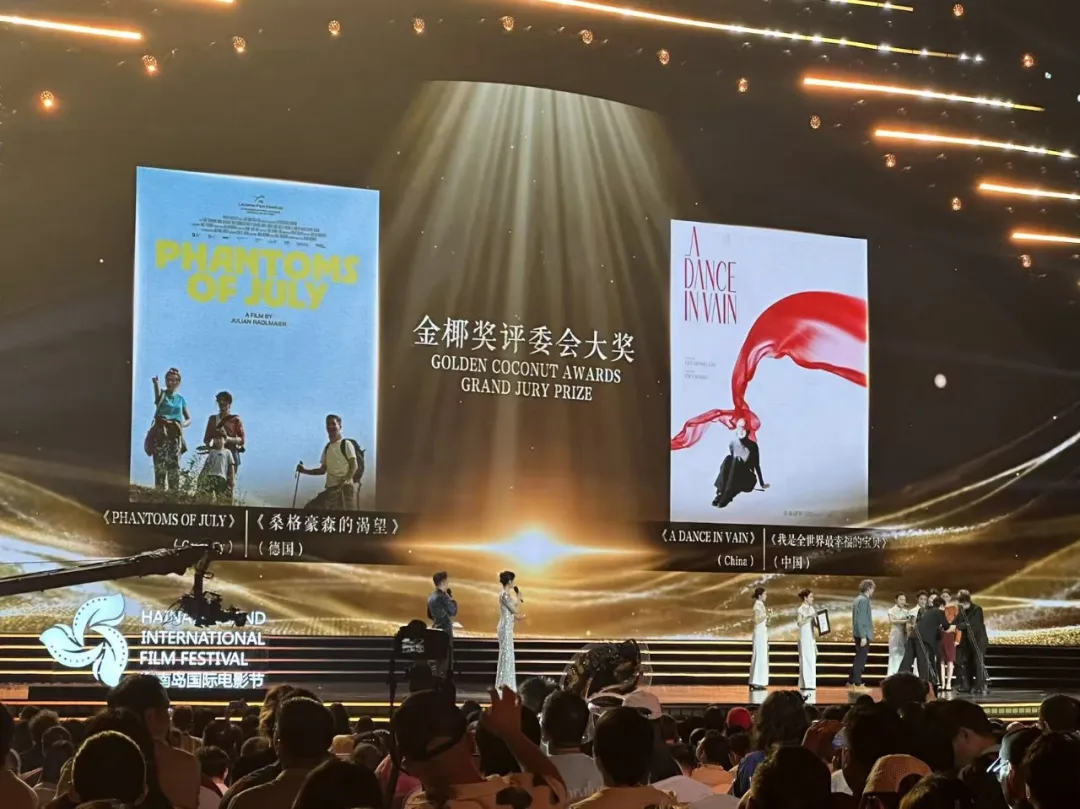
"The Desire of Sangerhausen" and "I Am the Happiest Baby in the World" jointly won the Jury Grand Prize.
During his acceptance speech, director Li Hongqi gave special thanks to the leading actress Wang Zixuan. The two had just announced their marriage last month. When talking about the difficulties of filmmaking, Li Hongqi choked up at one point, and Wang Zixuan, who was sitting in the audience, also shed tears on camera.

"I Am the Happiest Baby in the World" is Li Hongqi's second feature film, written and directed after his Venice Film Festival award-winning work "Love Is a Gun." It stars his real-life partner, Wang Zixuan, who also serves as producer. The film explores the struggles of contemporary people in their creative endeavors, life, and self-identity from a unique perspective. Li Hongqi also acts as the cinematographer in the film, using a handheld camera throughout to capture the protagonist, played by Wang Zixuan, as she navigates the anxieties and helplessness of pursuing her dreams in the city.
Also sharing the same award were the films *The Blue Heron* and *Bringing the Storm*, both winning the Golden Coconut Award for Best Screenplay. Sophie Romvari's *The Blue Heron* demonstrates a precise and compelling grasp of character motivations and dramatic situations, maintaining a balance between pacing, dialogue, and character relationships, leaving a lasting impression on viewers. Miguel de Zuvilia's *Bringing the Storm* is not only clearly structured and well-paced, but also exhibits remarkable creative freedom, weaving together allegory and realism to present an extraordinary structural imagination. The creators of *Bringing the Storm* stated that this award is of great significance to them, "because Argentina is going through a difficult time, and this will inspire more people to continue making films."
In the acting categories, Theodore Perrin won Best Actor for his outstanding performance in *Nino*. The Best Actress category saw a trio win, with Destiny Checo, Johanna Florentino, and Natalie Navarro from *The Crazy Bill* sharing the award for their seamless collaboration and superb acting. Each actress portrayed a different character, showcasing their emotions and fates in distinct yet equally authentic ways. The tension, contrast, and resonance between them brought the characters to life, fully revealing the complexity and diversity of the story.
The Best Contribution to Chinese-Language Cinema Award was given to the film "Summer Not Long Ago," which, with its keen cultural observations and authentic emotional expression, contributed a noteworthy voice to Chinese-language cinema. Director Ye Zhenpeng, upon accepting the award, stated that this student project, filmed during his junior year of university, involved a team of only nine people, and that the youth depicted in the film is a precious treasure for everyone throughout their lives.
The documentary and short film categories also featured many excellent works. Among them, *The Paper Ballad* won Best Documentary, a hybrid film that uses a Vietnamese elderly woman's urban journey as a narrative thread to deeply intertwine unfamiliar modern experiences with rural memories, presenting the subtle turbulence between individual life and ethnic culture. In *The Mine*, the camera moves between darkness and reflected light, merging imagination with the physicality of labor; the fictional scenes possess a remarkably realistic quality, and this film won Best Short Film.
In addition, the documentary "No Matter Where You Live" and the short film "Auntie" received the "Special Mention from the Jury" honor. The jury hopes to use this honor to recognize the unique exploration and outstanding highlights of the two works in their creation.
Building on the landmark achievement of Hainan Island's full customs closure, the Hainan Free Trade Port is entering a new stage of opening up to the highest level in China. The 7th Hainan Island International Film Festival thus became a cinematic rendezvous that transcended mountains and seas, attracting 4,564 films from 119 countries and regions—a record high for the festival. Over the past seven days, films from around the world have converged and resonated on this vibrant and open land of Hainan, jointly building a brilliant bridge connecting Eastern and Western cinematic civilizations.

Full list of winners